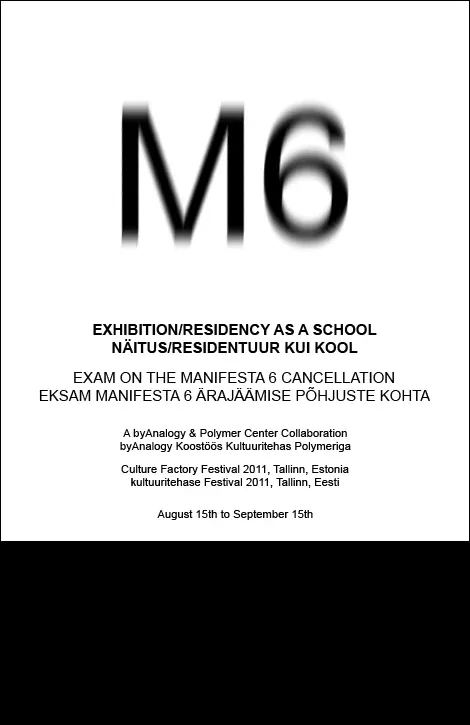
M6 : Exhibition/Residency as A School - The Art Container with The Polymer Residency Program, Tallinn, Estonia, August 15th - September 15th, with a possibile residency from August 15th to November 15th, 2011
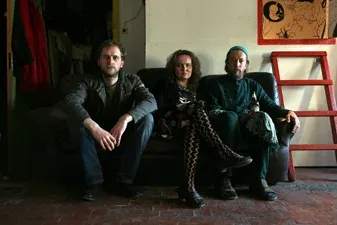
"M6" offers a return to the base, the art school. Through its exhibition-residence performance concept, artists will be invited to an international study meeting with Estonia on the aesthetics of resistance, an artist's attitude. This grouping will be done by bringing together the Art Container, mainly Estonians and Russians, some of whom come from outside the country, but live in the places, including their representative in Quebec, Sylvain Breton, known for his participation in the Non Grata art collective between 2005 and 2011 under his pseudonym "Brownhair Blond".
Made up of different countries, this coexistence of the alternative and the atypical will be done by examining the pressures that led to the European Biennial Manifesta 6 of 2006 cancellation, in Cyprus. This attitude mixture of the institutional and the atypical, a dear theme and rich in aesthetic content of Harald Szeemann's famous 1969 exhibition in Bern "When Attitudes Become Form," will this time be confronted, of course, between art and texts on the mainstream issue, what they are not, not being part of, but more interesting will make the bitter realization of a local reality much harder, lacking hope, than the reality of guests on this Atlantic side of the world where artists emerge mainly from major subsidies.
In other terms, within this art of resistance no submitted dossier will be juried and only the experience of an art university institution will suffice. This willingness exhibition-residency performance art form in the Art Container, in an outdated, but known Polymer Factory, will be in production rupture convention with gallery and museum well organized, subsidized because economy wise structured. The exam will propose then a re-reading of the said biennial documentation, but in the East occupation, and again, by this rubbing of the vacuum for one, the contemporary for the other, an identity of the professionalization for some or success and abandonment for the other.
Members of the Polymer Centre & Art Kontainer: Erik Alalooga, Sandra Jõgeva & Tanel Saar, Tallinn, Estonia.
Confirmed participations: Gabriela Golder (Buenos Aires), André Éric Létourneau (Montréal), Jessica Maccormack (Montréal), Lance McLean (Edmonton), Cendrillon Bélanger (Paris), Patrick Bérubé (Montréal), Sylvain Breton (Montréal), Jérémie Carvalho (Montréal), Sophie Castonguay (Montréal), Doyon/Demers (Québec), Xavier Demoulin (Paris), Anne-Marie Dumouchel (Montréal), Soleda Sánchez Goldar (Buenos Aires), Sandra Jõgeva (Tallinn), Simon Lafreniere (Montréal), Wen Lee (Singapore), Alain Lefebvre (Cornwall), Fernanda Mejía (Bogota), Orion Maxted (London), Frédéric Saia (Laurentides), Tanel Saar (Tallinn), Dominique Sirois (Montréal), Julie Andrée T (Montréal).
Program: August 1–10, 2011, arrival (opening period, preparations); August 12, 2011, 10 a.m., the M6 exam (12 questions on the cancellation of Manifesta 6); August 15 – September 15, 2011, the exhibition (only the artists who pass the exam) and workshops, seminars and performances (all participating artists); August 20, the lecture Aesthetics of Resistance (Sylvain Breton); August 15 – end of November 2011, an extended residency (voluntary, with the Art Container’s approval).
The 12 texts from Manifesta 6 (Notes for an Art School): Mai Abu ElDahab, On How to Fall With Grace—or Fall Flat on Your Face; Anton Vidokle, Exhibition as School in a Divided City; Florian Waldvogel, Each One Teach One: Adorno’s “Thinking is action, theory is a form of practice”; Babak Afrassiabi & Nasrin Tabatabai, Practice of Indecisiveness; Julie Ault & Martin Beck, Drawing Out & Leading Forth; Liam Gillick, Denial & Function: A history of disengagement in relation to teaching; Walid Sadek, A Room With a Conversation in the Middle; Boris Groys & Anton Vidokle, Art Beyond the Art Market; Jan Verwoert, School’s Out!-?; Olaf Metzel, SayNoProduction; Haris Pellapaisiotis, Speaking Thoughts: On an Art School; Tobias Rehberger and Mai Abu ElDahab, Kitsch, Destruction & Education.
Production, conception and realisation: Sylvain Breton, byAnalogy.org. Translations: Charlotte de Celles (English to French) and Adriana Palanca (French to English). Partner: Kunstikonteiner, Kultuuritehas Polymer, Tallinn, an artist-run centre, supported by the Estonian Ministry of Culture and the Cultural Endowment of Estonia.
With still no money or fund for this professional event nor for artists.