Journal as a visual document-portfolio, it reflects the artist’s ideas and practice in contemporary art, since his September 2005 productive pause. Analyzing a critical mess of an internationnal art professionalization, this document place a perspective community influences from both the alternative and the institutional artist’s experience towards collaborations, such as Orange-Brown, CAROL BRUNO and NON GRATA from Estonia.
In performance art, not anymore related to the conventional gallery space object, to not forget who we are and what we can become, alternative and institutional, "the artist" may be the significant reason to the publication.
Below, an interview under the gemini concept of the "artist" used to present his catalog.
The Gemini Interview
Gemini: Why this catalog now?
Breton: It’s intended to raise awareness about my artistic practice, and to help refine my goals as a collaborator and as a speaker. Also, most of my shows have happened abroad, in Europe and Asia. It seemed like the right time to make local audiences more aware of what I do, especially since my work only exists thanks to media and photographic documentation. At some point, an artist must display their works in order to keep evolving as an artist.
Gemini: Why put on a show in the East?
Breton: I decided to have an exhibition in the East because it’s far away from the frenzied marketing and professional hysteria of western art galleries and museum institutions. There is less administrative work for the artist, but without impacting the quality of the show. There is much less compromise required of artists in the East and the artistic motives are clear.
In my opinion, our art galleries are no longer promoting escaped art; rather, they legitimate grant-supported art domination with an economy alignment. But art is never clean, it does not conform to the Duchampian Fountain. True art, that something else (Gombrich, 2008), is somthing never meet, never exhibitionable, it is a Fountain and as such, never beautiful, never conforming to the politics and language of art, and never elegant as a mirror for a museum.
True art is political, revolting, destructive, disturbing, stressful, intense and hysterical; and because it cannot be controlled or directed, art is difficult to understand and hard to defend. But art is also emotional, captivating, and individualized, a private experience. It is an artistic agency of possibilities and impossibilities; it cannot be attached to the post-conceptual legitimation, because this pratice does not follow as an absolute the duchampian program. So is it a question of there being a permanent disconnectivity with our academic concepts about art? Such of art is probably past or is it a potentially brand new form.
The priority right now is to find a new critical structure that is not based on the artist’s work or on the artist’s reputation. All artists, even important one, are capable of behaving badly. Only a market or an economy-based art would neglect that fact.
When I left university, I followed my appetites, carving out my practice not in a most easiest artistic discipline if someone wants to make a career out of visuals arts locally in Quebec, a network still limited because of its consensual entrave; so it was in the impopular performance. My catalog is thus an introduction of such practice, fully aware of the inherent stakes and politics that are involved. It represents my artistic practice in Europe and Asia – and barely in the United States. In my opinion, performance are suited to a northern or Asian context, East artists, not producers.
Gemini: You have participated in numerous collectives. Where they formative to the point of helping you to develop a legitimate aesthetic vision with many layers?
Breton: Indeed. Legitimate or not, these works represent my local activities in Montreal, initially with the orange brown collective. Mostly Anglophone, these artists were primarily associated with Concordia University, but there were some international members as well. It was a refreshing experience.
I began my international efforts while still with the collective, and after a year spent living on the York University campus in Toronto – an experience made possible thanks to my increased comfort with the English language. I travelled also through Europe and Asia with my CAROL BRUNO art collective. It was an intense outland experience, especially with the Sotodo Gallery Performance Art Congresses organized by its director, the artist Theodor Di Ricco; we had good exposure as artists.
I launched my solo career in Estonia, Finland, Argentina, Germany and in the United States, primarily in the states of New York and Missouri, specifically, at the St. Louis Contemporary Art Museum. Following an artistic residency at La Recoleta in Argentina, thanks to support offered by the Conseil des arts et des lettres du Québec, I then went on to curate art for the NON GRATA collective.
As part of the NON GRATA collective in Estonia, my aesthetic expectations were de rigueur, because according to the precepts of ritual and atypical work, which rarely comprise post-Duchampian concepts, these pratices are derivative and thus difficult to track. They are in permanent disconnectivity with the present.
While researching practices and exhibitions, I noticed a lack of critical judgment and nervous commentary being made by individuals who don't understand concepts, who are distanced from private experience. Works should be individualized and speak to the private. They should draw attention to what is possible, what is impossible, and not follow a conceptual agenda. From this perspective, it's crucial to protect non-specialization, because that's the only place where true liberty can be found.
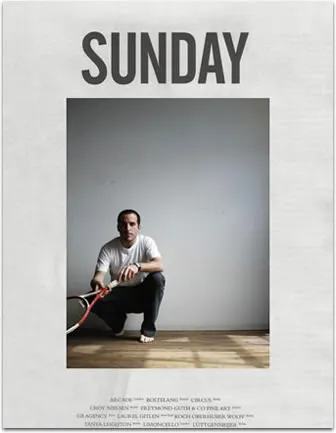
Gemini: What is the inspiration for the title “SUNDAY You're Fired!”?
Breton: This exhibition is based on conceptual fascinations. Starting with the word “Sunday”, the title contains different meanings and evokes various elements of performance and action.
Strongly attached to the economy, the word "Sunday" still elicits the notion of “a day of rest”, but in an outdated Judeo-Christian sense. Il renvoi à ce mouvement syntaxique par concept performatif, équivalant au corps de l’artiste en performance. In that the objects, words and images possess performative value. In my opinion, it’s all a question of performativity. Sunday is also a day for artists to spend outside the atelier, in the sunlight. But even then we are creating. The concept of Sunday as a day of rest is a falsehood, because artists are always working, even on Sundays.
Gemini: And let’s talk about the “Great Law Breaker”, this fascinating artistic personality we find in contemporary art. Why is the great law breaker of interest to you?
Breton: In my opinion, Al Paldrok of the NON GRATA collective is the closest to this ideal. I identify both as fully embodying the concept of "The Law". This profile is an analogy between the radical artist and Donald Trump, who is best known for his stern expression, “You’re fired!” Forthright, these two individuals create laws. They invent their own language for law, and then proceed to live in perfect harmony with their system and all its flaws. They are thus responsible for their choice and for the path they chose as subversives. In my eyes, they are examples of possibility and impossibility. They live on the margin of what society dictates for the individual.
This personality breaks all rules and laws, motivated by fantasies of true independence. As the “Great Law Breaker”, the artist becomes a radical and finds freedom in this feeling. He's the Law! He has money! Glory! Totally independent, artists can, with the full darkness of their paranoia, turn their backs on their mothers, their fathers, and fully embrace their destructive aspects (Walter Benjamin).
But coming back to art, artists perceive conceptual art as a language of aesthetic laws that legitimize or prohibit the practice of art from making a symbolic connection between desire and intense pleasure.
Furthermore, this recent obsession puts the emphasis on the aesthetics of resistance through a professionalization of art in crisis (Dieter Roelstraete, 2011). This architecture of resistance poses some fundamental questions, such as how to connect or breathe life into a new critical structure, renewal, how to impose aesthetic concepts in ways other than by levelling off market politics, and how to position this resistance as a turning point in the education and thinking process of theoreticians, artists, and reviewers towards the controversial cancellation of Manifesta 6 in Europe.
Interviewed April 2011.
Bibliography: Stéphanie Moisdon et Bruce Hainley, Lycanthropize: The Critical under the Full Moon of Cross Genre, Curator’s Corner, Mousse, publication 19, 2009. E.H. Gombrich, Histoire de l’art, Phaidon, 1046 pages, 2006. Jimmie Durham, If Money Talks, What Language Does It Speak?, Talking About, Mousse, publication 26, page 23, 2011. Dieter Roelstraete, Critical mess: On the ruins of the Museum’s Research Department, Talking About Section, Mousse, publication 26, 2011, p.50. Steven Henry Madoff, Art School (Propositions for The 21th Century), édition Madoff, 2009.